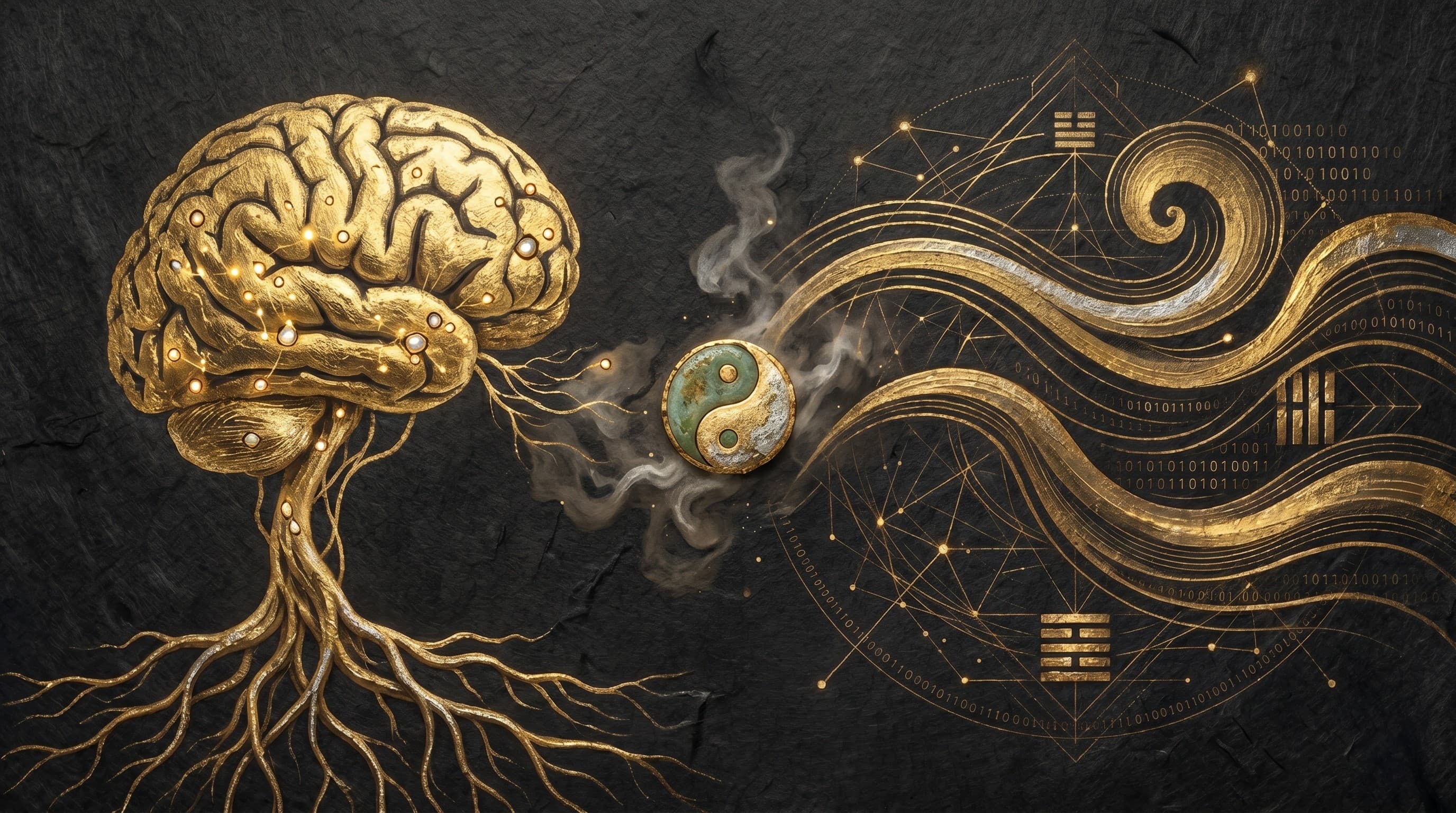
We live in a digital age that promises absolute control. Apps plan our every minute, smart homes turn on washing machines via mobile, and social media forces us to constantly optimize our performance. The result? Chronic stress, alienation, and the feeling that while we're running at 150%, we're actually just mechanically surviving.Zatímco západní svět na tento kolaps reaguje záplavou nových „biohackingových“ metod, prastará taoistická kosmologie Ham Yu nabízí elegantní, tisíciletími ověřené řešení: princip San Cai – dynamickou triádu Času (Nebe), Člověka (Ren) a Prostoru (Země). A co je nejvtipnější? Nejnovější vědecké objevy v neurologii a epigenetice jí dávají za pravdu.While the Western world responds to this collapse with a flood of new “biohacking” methods, the ancient Taoist cosmology of Ham Yu offers an elegant, millennia-proven solution: the principle of San Cai – the dynamic triad of Time (Heaven), Man (Ren), and Space (Earth). And the funniest part? The latest scientific discoveries in neurology and epigenetics prove it right.---## Tři herci reality: Když vesmír nechce dokonalost## Three Actors of Reality: When the Universe Doesn't Want PerfectionV západní kultuře máme tendenci vnímat realitu lineárně: já jsem tady a okolní svět je jen pasivní kulisa. Ham Yu naopak vidí realitu jako interaktivní divadlo tří herců, kde nikdo nestojí stranou:In Western culture, we tend to perceive reality linearly: I am here, and the surrounding world is just a passive backdrop. Ham Yu, on the other hand, sees reality as an interactive theater of three actors, where no one stands aside:* Čas (Nebe / Heaven Luck): Pulz, genetická výbava a energetický kód, který si neseme z okamžiku prvního nádechu.* Time (Heaven / Heaven Luck): The pulse, genetic makeup, and energetic code we carry from the moment of our first breath.* Prostor (Země / Earth Luck): Architektura, krajina a sezónnost, které nás formují.* Space (Earth / Earth Luck): Architecture, landscape, and seasonality that shape us.* Člověk (Man Luck): Vědomá volba a most, který obě tyto energie propojuje.* Man (Man Luck): Conscious choice and the bridge that connects these two energies.Vtip je v tom, že moderní medicína i vesmír absolutně odmítají naši obsesi dokonalostí. V Ham Yu platí, že přílišná symetrie a statická dokonalost se rovnají nehybnosti – tedy smrti. Vesmír miluje asymetrii a dynamickou proměnu. Naše drobné „nedokonalosti“ jsou ve skutečnosti evolučním motorem, který nás nutí adaptovat se a hledat vlastní, specifickou životní cestu.The irony is that both modern medicine and the universe absolutely reject our obsession with perfection. In Ham Yu, excessive symmetry and static perfection equate to immobility – meaning death. The universe loves asymmetry and dynamic change. Our minor “imperfections” are actually an evolutionary engine that forces us to adapt and seek our own, specific life path.---## Neurologie prostoru: Proč vaše játra nesnáší harmonogramy## Neurology of Space: Why Your Liver Hates SchedulesJedním z nejvíce fascinujících aspektů Ham Yu je učení o tom, jak prostor přímo zrcadlí naše tělo. Podle této prastaré fyziky má dům svá vlastní „záda“ (černá želva) a „obličej“ (rudý fénix) bez ohledu na to, kam ukazuje kompas.One of the most fascinating aspects of Ham Yu is the teaching of how space directly mirrors our body. According to this ancient physics, a house has its own “back” (black tortoise) and “face” (red phoenix) regardless of where the compass points.Když se podíváme na element Dřeva, který v těle odpovídá játrům a žlučníku, mluvíme o energii expanze, vizí a svobody. Víte, co tato energie z duše nejvíc nesnáší? Rigidní harmonogramy a stísněné prostory.When we look at the element of Wood, which in the body corresponds to the liver and gallbladder, we are talking about the energy of expansion, vision, and freedom. Do you know what this energy hates most from the soul? Rigid schedules and confined spaces.> Neurologický korelát: Moderní neurověda dnes mluví o tzv. place cells a grid cells v mozku (objev oceněný Nobelovou cenou), které mapují náš prostor. Pokud je člověk dlouhodobě uzavřen v nízkém, stísněném prostoru (třeba pověstné panelákové králikárny) a svázán přísným časovým plánem, mozek to vyhodnotí jako stav ohrožení. Dochází k chronické aktivaci amygdaly, vyplavování kortizolu a následnému rozvoji tísně, agresivity či psychosomatických poruch.>
Prastará Čína to věděla dávno: stísněný prostor a nasekaný čas stlačují játra, generují jaterní oheň a vedou k frustraci. Naopak velkorysé prostory s dalekým horizontem otevírají mysl a posilují imunitu.>> Neurological Correlate: Modern neuroscience today speaks of place cells and grid cells in the brain (a Nobel Prize-winning discovery) that map our space. If a person is long-term confined to a low, cramped space (such as the proverbial rabbit hutches of paneláks) and bound by a strict time schedule, the brain interprets this as a state of threat. This leads to chronic amygdala activation, cortisol release, and subsequent development of anxiety, aggression, or psychosomatic disorders.>
Ancient China knew this long ago: cramped space and fragmented time compress the liver, generate liver fire, and lead to frustration. Conversely, generous spaces with a distant horizon open the mind and strengthen immunity.---## Energetický upír v kapse: Daň za digitální zneužití prostoru## The Energetic Vampire in Your Pocket: The Price of Digital Space MisuseV Ham Yu existuje pravidlo: pokud na nějakou věc nesáhnete tři roky, stává se z ní energetický upír, který oslabuje Qi daného místa. Dřív to byly zaprášené truhly na půdě, dnes jsou to kuchyňské zlostrojky, které po dvou použitích schováme do skříně.In Ham Yu, there is a rule: if you don't touch something for three years, it becomes an energetic vampire that weakens the Qi of that place. In the past, these were dusty chests in the attic; today, they are kitchen gadgets we put away after two uses.Ale ten největší problém současnosti nosíme neustále u sebe – chytré telefony a notebooky. Ve chvíli, kdy si přinesete práci na počítači do společenského prostoru obýváku nebo ložnice, nevědomky měníte kód reality. Vkládáte technologii a pracovní tlak do samotného středu (Tai Ji) své rodiny. Výsledkem je rozmělnění hranic, neschopnost vypnout a degradace lidských vztahů na úroveň mechanických interakcí. Neustále zrychlujeme čas slovem „MUSÍM“, což je čistě jangový tlak, který doslova spaluje naše vnitřní palivo.But the biggest problem of the present we carry with us constantly – smartphones and laptops. The moment you bring computer work into the social space of the living room or bedroom, you unknowingly change the code of reality. You insert technology and work pressure into the very center (Tai Ji) of your family. The result is blurred boundaries, an inability to switch off, and the degradation of human relationships to the level of mechanical interactions. We constantly accelerate time with the word “I MUST,” which is purely a Yang pressure that literally burns our internal fuel.---## Psychologie batohu: Proč potřebujeme rituály## The Psychology of the Backpack: Why We Need RitualsČíňané (i ti nejchudší) tradičně žili nesmírně cyklicky. Měli čtyři sezónní truhly na oblečení a v mezidobí elementu Země (leden, duben, červenec, říjen) symbolicky „svlékli“ minulé období. Ham Yu říká, že my na západě žijeme jako blázni: v deseti letech si nasadíme na záda batoh se starostmi a křivdami, a v padesáti do něj pořád jen nakládáme, aniž bychom ho kdy sundali.The Chinese (even the poorest) traditionally lived immensely cyclically. They had four seasonal chests for clothes and, in the interims of the Earth element (January, April, July, October), symbolically “shed” the past season. Ham Yu says that we in the West live like madmen: at ten years old, we put a backpack full of worries and grievances on our backs, and at fifty, we're still just loading more into it without ever taking it off.Proto jsou v Ham Yu tak klíčové rituály. Rituál není esoterické divadélko. Je to vědomé zastavení času, vytvoření „bezčasového ostrova“ (kontemplace), který umožňuje přetavit syrové informace do hluboké životní zkušenosti.That's why rituals are so crucial in Ham Yu. A ritual isn't an esoteric play-act. It's a conscious stopping of time, creating a “timeless island” (contemplation) that allows raw information to be transformed into deep life experience.> Psychologický pohled: Z pohledu moderní psychologie fungují rituály jako kognitivní kotvy. Pomáhají našemu neuroendokrinnímu systému přepnout z režimu „bojuj, nebo uteč“ (sympatikus) do režimu hojení a regenerace (parasympatikus). V tišině mezi koncem jedné myšlenky a začátkem druhé dáváme tělu šanci opravit poškozené buňky.>> Psychological Perspective: From the perspective of modern psychology, rituals function as cognitive anchors. They help our neuroendocrine system switch from “fight or flight” mode (sympathetic) to healing and regeneration mode (parasympathetic). In the quiet between the end of one thought and the beginning of another, we give the body a chance to repair damaged cells.>
---## Cesta je cíl## The Journey is the DestinationPokud se neustále honíme za dokonalým výsledkem, kupujeme si nová technická udělátka a optimalizujeme své životy podle tabulek, jdeme podle starých mistrů přímo do pekel. Dokonalost je fixní, nehybná – a v přírodě je nehybnost stavem konce.If we constantly chase perfect results, buy new gadgets, and optimize our lives according to spreadsheets, we are, according to the ancient masters, heading straight to hell. Perfection is fixed, immobile – and in nature, immobility is the state of the end.Skutečná harmonie spočívá v tom, že přijmete svou nedokonalost, naučíte se vnímat potřeby svého těla i prostoru a občas ten těžký batoh plný digitálního šumu jednoduše odložíte. Protože jak říká Ham Yu: Cesta je cíl a proměna je jedinou konstantou. To, jakou kvalitu té proměně dáte, je ale na vaší svobodné vůli.True harmony lies in accepting your imperfection, learning to perceive the needs of your body and space, and occasionally simply putting down that heavy backpack full of digital noise. Because as Ham Yu says: The journey is the destination, and transformation is the only constant. But the quality you give to that transformation is up to your free will.---Stop Constantly "FIXING" Yourself. You're Not Broken! You're Just Driving Through Life with the Handbrake On.